Bing Webmaster Tools’ New AI Performance Section: What It Means for Search Visibility

.svg)
With the arrival of AI Overviews, Answer Engines, and LLM Chatbots, search has fundamentally changed. Rankings still matter, but AI-generated answers now summarize content, cite sources, and shape decisions before a user clicks a traditional listing.
Bing Webmaster Tools’ new AI Performance section formalizes this shift. It provides direct reporting on how your content appears within AI-generated search experiences, revealing how search engines interpret your authority and whether those appearances generate measurable traffic.
What Is the AI Performance Section?
The AI Performance section tracks how your website appears inside AI-generated responses. Traditional reports measure impressions, clicks, and rankings within standard listings. This section measures inclusion within generative answers.
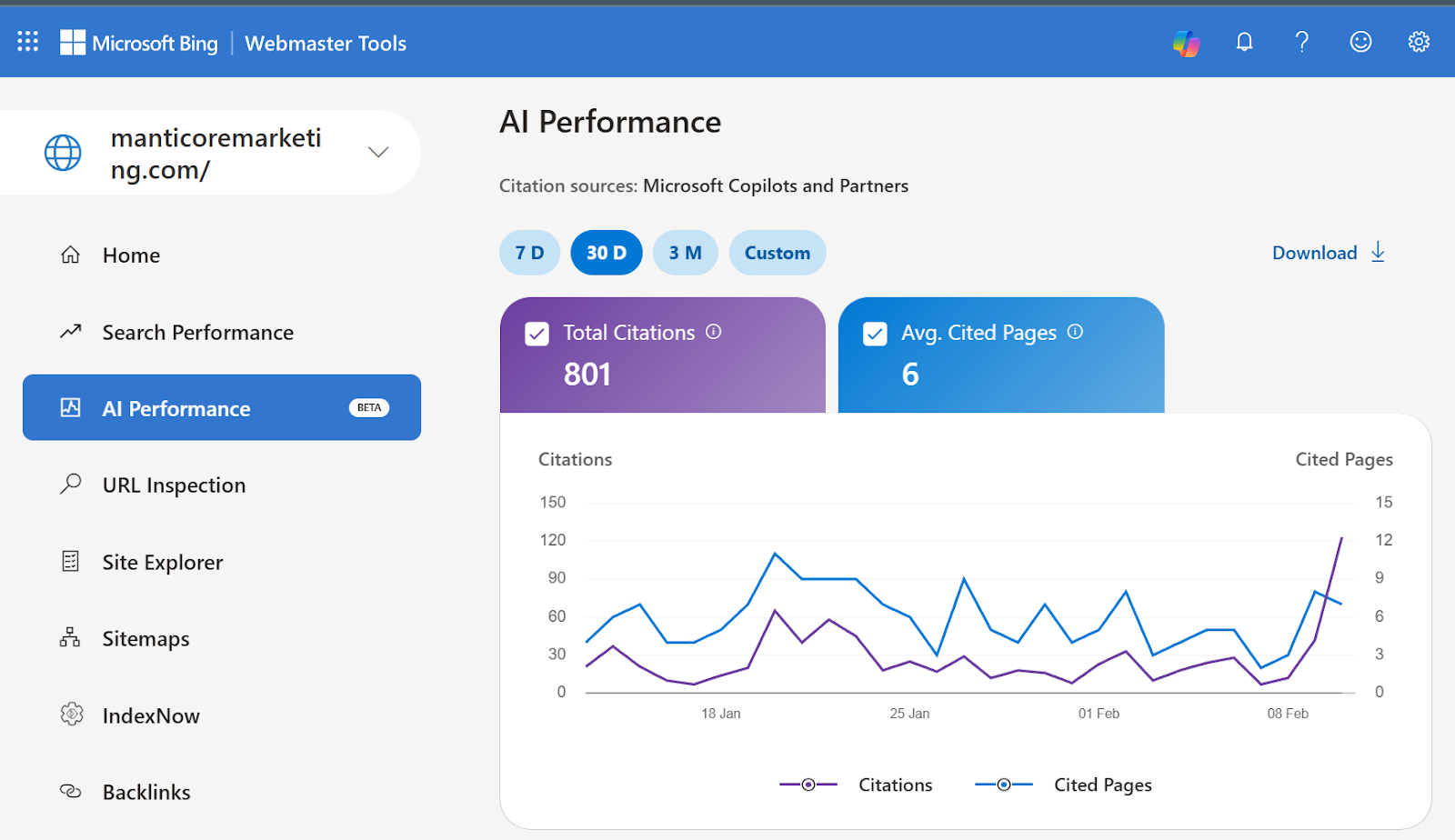
The report centers on three primary metrics:
- AI Impressions: Measures how often your content is surfaced in AI-generated answers (summarized references, source attributions). It signals influence: your content contributed to the answer.
- AI Clicks: Measures traffic generated when a user proceeds to your site from an AI-powered response.
- AI Click-Through Rate (CTR): Reflects how often users move from AI answers to your website. Lower CTR often indicates strong informational alignment—the AI summary satisfied the user's intent.
Traditional SEO centers on ranking position. AI reporting centers on contextual authority.
There is no "position one" inside a generative answer. Your content may serve as the primary summarized source or appear as a cited reference. Visibility is now multidimensional, measured by contribution, not placement. Success is about being incorporated into the answer.
The update reinforces SEO fundamentals but shifts emphasis toward clarity, authority, and structure.
- Structured, Direct Answers Win: AI systems prioritize concise, well-organized information. Pages using clear headings and direct answers are more likely to be incorporated into AI summaries.
- Authority is Non-Negotiable: Backlinks and domain authority still influence whether your content is trusted. Weak content in traditional search is unlikely to appear in AI responses.
- Informational Content Gains Value: AI systems frequently summarize explainer articles, definitions, and guides. Invest in educational content to capture early-stage research.
What are Grounding Queries and how do They Appear in the AI Performance Dashboard
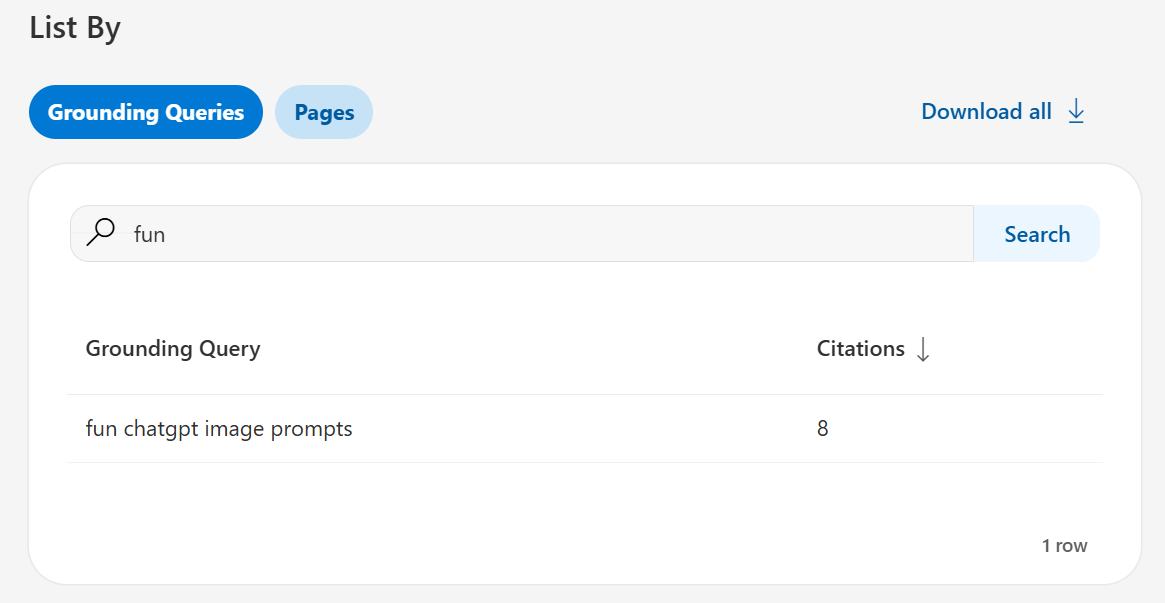
Grounding queries in the AI Performance report inside Bing Webmaster Tools refer to search queries where Bing’s AI system retrieved live web content to construct its generated response. Instead of relying solely on its underlying language model, the AI “grounds” its answer in real-time, authoritative sources across the web.
When your site appears within a grounding query, it means your content was selected as part of the retrieval process that informed the AI-generated answer. This is not simply a ranking signal. It indicates that Bing’s AI considered your page credible, relevant, and structurally usable enough to help shape the response presented to the user.
Inside Bing Webmaster Tools, grounding queries help you understand:
- Which search queries triggered AI retrieval behavior
- Where your content was used to support AI responses
- How often your pages were cited in generative results
Grounding queries act as the bridge between the query and the citation. They answer the question: “Which searches made Bing retrieve my content to construct an AI response?”
Grounding queries are powerful because they show topic-level authority, not just ranking visibility.
If your site appears frequently in grounding queries:
- You are being treated as a reliable source
- Your content is structurally extractable
- Your information aligns with user intent
- You are influencing early-stage research behavior
If you are not appearing:
- Your content may lack clarity
- Your technical structure may limit extraction
- Authority signals may be insufficient
- Competitors may be structurally stronger
What Content Performs in AI Results?
AI systems prioritize clarity, structure, and topical depth. High-performing assets typically include:
- Comprehensive explainer articles
- Clear industry definitions
- Comparative analysis guides
- Educational resources
- Structured FAQ sections
Concise answers under well-defined headings improve extraction accuracy. This is where content strategy and technical SEO converge. A disciplined content ecosystem increases both ranking performance and AI inclusion.
Your content strategy should be identifying the right questions to answer and the right format to answer them in, while your technical SEO strategy should be prioritizing webpage and schema structures that make it easier for AI tools to understand your content, which will in turn make them more likely to cite it.
The Technical Foundation Remains Non-Negotiable
When it comes to choosing a technical structure for your website, there is no separate AI optimization set of best practices. Core fundamentals determine inclusion:
- Clean HTML architecture
- Accurate indexing
- Logical heading hierarchy
- Structured data implementation
- Fast load performance
- Strategic internal linking
Weak technical frameworks reduce extraction accuracy and limit AI inclusion. So, similar to SEO, if your site is difficult for crawlers to understand, it will hurt your visibility. And similar to search indexing rules, you can set rules on your page to block AI crawling, which will make your content relatively invisible to these tools.
Many websites initially blocked AI crawlers and opted out of AI training to protect their data, but this also made it impossible for AI tools to cite these references when needed.
Strengthen Your Position in AI-Driven Search
Sustained performance in modern search requires technical precision, structured authority, and disciplined content architecture.
Manticore Marketing builds search ecosystems designed for long-term durability across both traditional and AI-driven results.
Meet with Manticore Marketing to evaluate how your website is positioned for AI visibility and sustained organic growth. Search has evolved. Your measurement framework should evolve with it.
Bing AI Performance Section - FAQs
What does the AI Performance section measure?
It measures how often your website appears within AI-generated search responses, including impressions, clicks, and click-through rates associated with those placements.
Does this replace traditional SEO reporting?
No. It supplements traditional metrics such as impressions, rankings, and organic traffic. Both layers must be analyzed together.
Why might AI impressions be high but clicks low?
AI-generated summaries may fully satisfy informational intent. High impressions with lower clicks often indicate strong authority rather than weak performance.
Can I optimize specifically for AI results?
There is no separate AI ranking system. Structured, authoritative, technically sound content increases the likelihood of inclusion.
Is this relevant for e-commerce websites?
Yes. Buying guides, educational content, and product comparisons frequently surface in AI responses and influence purchasing decisions.
How can I determine if my site is positioned properly?
A comprehensive SEO and technical audit identifies structural limitations, authority gaps, and content opportunities affecting both traditional and AI-driven visibility.
.png)